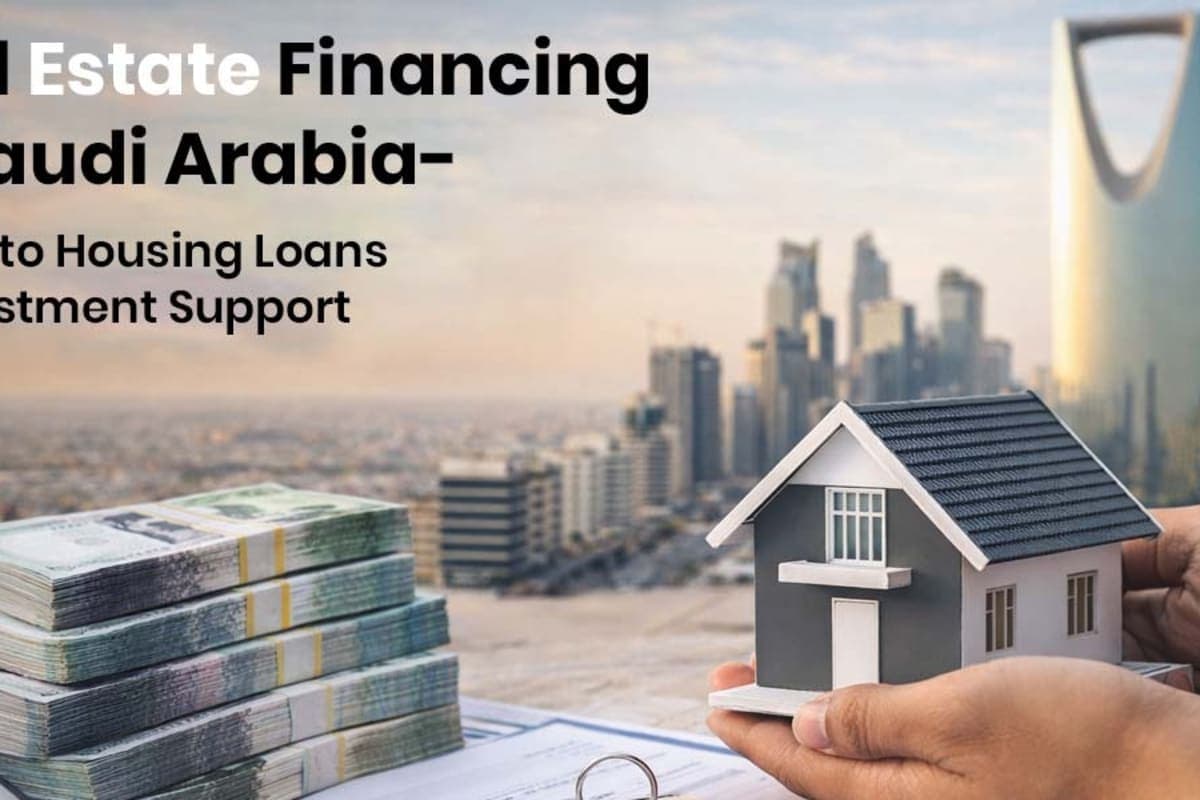
Real Estate Financing in Saudi Arabia – Guide to Housing Loans & Investment Support

Real Estate Financing in Saudi Arabia – Guide to Housing Loans & Investment Support
Real estate financing in Saudi Arabia has evolved rapidly over the past few years, becoming one of the most important pillars supporting the Kingdom’s property market and Vision 2030 growth strategy.
In 2026, financing is no longer limited to traditional bank loans. Today, a wide range of mortgage solutions, government-backed housing programs, and investor-friendly financing models are available for both Saudi citizens and expatriates. From first-time homebuyers to international investors, access to property funding has become significantly more structured, transparent, and accessible.
In our experience working with property buyers and investors across Riyadh, Jeddah, and emerging cities, financing has become the key enabler that transforms intent into actual ownership. Without proper financing strategies, even high-income professionals often struggle to enter the real estate market at the right time.
Government platforms such as Ejar digital contracts, Najiz property registration, and financing regulations guided by the Saudi Central Bank (SAMA) have strengthened trust and security across the sector. This has made Saudi Arabia one of the most rapidly modernizing real estate financing markets in the Middle East.
What Is Real Estate Financing in Saudi Arabia and Why Does It Matter?
Real estate financing in Saudi Arabia refers to the structured process through which individuals, investors, and developers obtain funds to purchase, build, or expand property assets—whether residential apartments, villas, or commercial real estate.
In simple terms, it acts as the financial backbone of the entire property ecosystem, enabling both citizens and expatriates to access homeownership and participate in the Kingdom’s expanding real estate opportunities.
In a country undergoing rapid transformation under Vision 2030, real estate financing plays a strategic role far beyond individual ownership. The Saudi government has set an ambitious target to increase homeownership rates from around 47% to nearly 70% by the end of the decade. Achieving this goal depends heavily on accessible mortgage products, flexible repayment structures, and government-supported housing initiatives.
Today, financing solutions are designed to support:
• first-time homebuyers entering the market
• middle-income families upgrading housing
• expatriates planning long-term residency
• investors targeting rental income and capital appreciation
Beyond personal ownership, real estate financing also drives economic growth. Every mortgage issued contributes to construction activity, job creation, infrastructure expansion, and private sector development.
As a result, financing is no longer just a financial tool—it is a core engine behind Saudi Arabia’s real estate expansion and economic diversification strategy.
How Has Real Estate Financing Evolved in Saudi Arabia?
Just two decades ago, real estate transactions in Saudi Arabia were largely cash-driven, with limited access to structured mortgage systems. Buyers relied heavily on personal savings, employer support, or informal family financing, which restricted property ownership to a smaller segment of the population.
This began to change in the early 2000s when the Saudi Central Bank (SAMA) introduced formal regulations for housing finance and established a controlled framework for licensed mortgage providers. These early reforms laid the foundation for a more organized and scalable financing ecosystem.
A major turning point came with the creation of the Real Estate General Authority (REGA) and later the Saudi Real Estate Refinance Company (SRC)—a government-backed institution designed to stabilize liquidity in the mortgage market. By purchasing home loans from banks and refinancing them, SRC enabled lenders to issue more loans while maintaining long-term financial stability.
Following the launch of Vision 2030, Saudi Arabia accelerated its transformation of the housing finance sector. Digital platforms, e-mortgage registration systems, and API integrations with the Ministry of Municipal and Housing (MOMRAH) significantly reduced approval timelines—from several weeks to just a few days in many cases.
Today, Saudi Arabia’s real estate financing ecosystem is considered one of the most advanced in the GCC. It combines Sharia-compliant financing models, government-backed subsidies, and AI-driven credit risk assessment systems to support a growing base of tech-savvy buyers and international investors.
Major Types of Real Estate Financing in Saudi Arabia (2026)
Saudi Arabia offers multiple financing options tailored to different income levels, religious preferences, and investment strategies. Understanding these financing models is essential for choosing the right structure based on your financial goals and eligibility.
1. Traditional (Commercial) Financing
Conventional real estate financing remains one of the most widely used options in Saudi Arabia, particularly among salaried professionals and corporate employees. These loans are typically offered by major banks and are structured around interest-based repayment models regulated by SAMA.
Eligibility for traditional financing is assessed based on several financial indicators, including income stability, credit history, employment profile, and existing liabilities. For expats and high-income professionals, this remains one of the fastest ways to secure property ownership.
Key features of commercial financing include:
• Fixed or variable interest rates linked to SAMA benchmark rates
• Loan-to-value (LTV) ratios typically ranging between 80% – 90%
• Loan tenures extending up to 25 years
• Early settlement options after a defined lock-in period
Commercial financing is especially preferred for its predictability and speed. Banks such as Saudi National Bank (SNB), Riyad Bank, and Arab National Bank dominate this segment with competitive offerings and digital loan approval systems.
Pros:
• Fast approval timelines with digital processing
• Competitive rates for salaried professionals
• Clear and predictable EMI structures
Cons:
• Interest-based (non-Sharia compliant) structure
• Early repayment penalties in some cases
• Higher eligibility requirements for expats
2. Islamic Real Estate Financing (Sharia-Compliant)
Islamic financing is the dominant financing model in Saudi Arabia, accounting for a significant share of the housing finance market. These structures comply with Sharia principles, avoiding interest (riba) and instead focusing on asset-backed and profit-sharing arrangements.
Rather than lending money directly, the bank participates in the transaction by purchasing the property and selling or leasing it to the customer under predefined profit terms. This creates a transparent and ethically structured financing model aligned with Islamic finance principles.
The most commonly used Islamic financing models include:
Murabaha (Cost-Plus Financing)
The bank purchases the property and sells it to the buyer at a fixed profit margin, payable in installments over time.Ijara (Lease-to-Own Model)
The bank retains ownership of the property while the customer pays rent, gradually transferring ownership over the agreed tenure.Musharakah (Partnership Model)
Both the bank and the buyer jointly invest in the property, with ownership gradually transferring to the buyer over time.
Major Islamic financing providers in Saudi Arabia include:
• Al Rajhi Bank – leading Sharia-compliant lender offering Murabaha financing with competitive profit rates
• Alinma Bank – provides flexible Ijara and Musharakah financing options
• Bank AlJazira – known for hybrid financing models and digital approvals
Advantages:
• Fully Sharia-compliant financing structure
• Transparent contracts backed by real assets
• Stable and predictable profit-based repayments
Drawbacks:
• Slightly higher upfront administrative costs
• More documentation and compliance checks
• Longer approval timelines in some cases
Today, Islamic financing accounts for over 65% of total housing loans in Saudi Arabia, reflecting strong consumer preference and regulatory alignment.
3. Government-Supported Financing Programs
To increase homeownership rates and make housing accessible to a wider population, the Saudi government has introduced several subsidized financing initiatives under Vision 2030.
These programs are particularly beneficial for first-time buyers and middle-income families who may not qualify for large private bank loans.
The most important programs include:
Real Estate Development Fund (REDF)
The REDF plays a central role in providing subsidized housing finance to Saudi citizens.
Key benefits include:
• Financing coverage of up to 100% for eligible applicants
• Interest-free or subsidized loan structures
• Loan amounts up to SAR 500,000
• Integration with over 40 financial institutions for faster approvals
• Digital tracking through the Sakani platform
Sakani Housing Program
Sakani is one of Saudi Arabia’s flagship housing initiatives, jointly managed by REDF and the Ministry of Housing.
The program offers:
• Ready housing units and land plots
• Construction financing support
• Subsidized mortgage options
• Digital application and approval systems
By 2024, more than 560,000 families had benefited from Sakani, with total financing exceeding SAR 40 billion, highlighting the scale and impact of government-backed housing initiatives.
Government financing programs continue to play a critical role in achieving Vision 2030’s goal of increasing national homeownership while ensuring financial inclusion across different income segments.
Eligibility, Conditions, and Requirements for Real Estate Financing in Saudi Arabia
While financing criteria can vary slightly across banks and government programs, most lenders in Saudi Arabia follow standardized guidelines under SAMA’s unified mortgage framework. This ensures consistency, transparency, and fair evaluation across applicants—whether Saudi nationals, GCC residents, or expatriates.
In 2026, banks have become more data-driven in their approval processes, combining traditional financial checks with digital verification systems linked to platforms like Najiz and SIMAH. This has made the eligibility process faster, but also more structured and compliance-focused.
Basic Eligibility Criteria
To qualify for real estate financing in Saudi Arabia, applicants must meet certain baseline requirements that reflect financial stability and repayment capability.
Most banks and financial institutions evaluate applicants based on the following:
• Nationality: Saudi citizens (eligible for REDF/Sakani programs) and expatriates or GCC nationals (eligible through private banks)
• Age Range: Typically between 21 to 65 years (some lenders extend up to 70 years for strong profiles)
• Minimum Salary: Usually between SAR 5,000 – 7,000 depending on bank and job category
• Employment Stability: Minimum 6–12 months for salaried individuals; 2+ years for self-employed professionals
• Down Payment Requirement: Generally between 10% – 20% of property value
For expatriates, eligibility may also depend on employer category, salary transfer agreements, and job sector (government-linked or multinational firms are often preferred).
Required Documents for Home Loan Approval
The documentation process in Saudi Arabia has become significantly streamlined due to digital integration across government and banking platforms. However, lenders still require a standard set of verified documents to assess risk and eligibility.
Applicants typically need to provide:
• Valid Saudi ID / Iqama
• Salary certificate or official income proof
• Bank statements (last 3–6 months)
• Property title deed and valuation report
• Employer’s NOC (No Objection Certificate)
• Approved property details and financing request form
In many cases, document verification is now integrated with digital platforms, reducing manual paperwork and improving approval timelines.
Creditworthiness and Debt Ratio (DBR)
One of the most critical factors in mortgage approval is the Debt Burden Ratio (DBR), which determines how much of your monthly income can be allocated toward loan repayment.
In Saudi Arabia, banks typically cap DBR at 45% of total income, ensuring that borrowers maintain a sustainable financial position without excessive debt exposure.
In addition to DBR, lenders assess your SIMAH credit score, which reflects your repayment history, existing liabilities, and financial discipline. A strong credit profile can:
• Increase approval chances significantly
• Help secure better profit or interest rates
• Reduce processing time for loan applications
For serious buyers, improving credit health before applying can make a substantial difference in financing outcomes.
Pro Tips for Financing Approval (2026)
From our experience working with buyers across Saudi Arabia, small financial decisions before applying can significantly improve approval success and loan terms.
Here are a few practical strategies:
• Clear existing credit card dues and short-term liabilities
• Opt for shorter loan tenures to reduce total repayment cost
• Compare multiple banks for profit rates and hidden fees
• Maintain a consistent salary record with proper documentation
These steps not only improve approval chances but also align with SAMA’s goal of building a stable and responsible mortgage ecosystem in the Kingdom.
Can Foreigners Get Real Estate Financing in Saudi Arabia? (2026 Update)
Until recently, real estate ownership and financing were largely limited to Saudi nationals. However, with regulatory reforms and the introduction of the Saudi Real Estate Ownership Law 2023, the Kingdom has significantly opened its property market to expatriates and international investors.
Today, foreign buyers can access both property ownership and financing opportunities in select regions, especially in major cities and strategic development zones aligned with Vision 2030.
Legal Framework for Foreign Property Ownership
Foreign investors are now allowed to own and finance residential and commercial properties in several approved locations across Saudi Arabia.
Key highlights include:
• Ownership permitted in major cities such as Riyadh, Jeddah, and Dammam
• Special economic zones like NEOM, King Abdullah Economic City, and Red Sea Global offer enhanced ownership rights
• Non-Saudis must hold a valid residency permit (Iqama)
• Financing approvals are regulated under SAMA guidelines
These reforms are designed to attract global capital while maintaining regulatory control and market stability.
Financing Options for Foreigners and Expats
With growing international demand, several local and international banks now offer tailored mortgage products specifically for expatriates and foreign investors.
These financing solutions vary based on income structure, residency status, and property type.
Available Bank Options (2026)
Bank | Eligibility | Financing Type | Tenure | Notes |
|---|---|---|---|---|
HSBC Saudi Arabia | Expats with salary transfer | Commercial | Up to 20 yrs | Global banking support |
Riyad Bank | Expats & investors | Islamic / Conventional | Up to 25 yrs | Online pre-approval |
Arab National Bank (ANB) | GCC citizens | Commercial | Up to 20 yrs | Fast processing |
SNB AlAhli | Foreign investors | Islamic (Murabaha) | Up to 25 yrs | Property + land financing |
These options reflect the increasing flexibility in Saudi Arabia’s financing ecosystem, making it easier for expatriates to participate in the real estate market.
In recent years, these reforms have contributed to increased foreign investment inflows, urban development, and diversification of property ownership across the Kingdom.
Top Banks and Real Estate Financing Companies in Saudi Arabia (2026)
Saudi Arabia’s real estate financing ecosystem is supported by a strong mix of Islamic banks, commercial lenders, and government-backed institutions. These entities play a critical role in expanding access to home loans, improving liquidity, and supporting long-term property ownership across the Kingdom.
In 2026, financing has become more competitive and digitally driven. Most banks now offer online pre-approvals, instant eligibility checks, and flexible repayment structures tailored to both Saudi nationals and expatriates.
Below is an updated overview of leading real estate financing providers in Saudi Arabia:
Leading Financing Institutions (2026 Overview)
Bank / Company | Financing Type | Profit / Interest Rate | Tenure | Special Feature |
|---|---|---|---|---|
Al Rajhi Bank | Islamic (Murabaha) | ~4.3% – 4.8% p.a. | Up to 25 yrs | Fully Sharia-compliant, fast approvals |
Saudi National Bank (SNB) | Commercial | ~4.8% – 5.4% p.a. | Up to 25 yrs | Strong corporate & expat financing |
Alinma Bank | Islamic | ~4.5% – 5.0% p.a. | Up to 25 yrs | Flexible Ijara & partnership models |
Saudi Real Estate Refinance Company (SRC) | Secondary Mortgage | Institutional | Long-term | Liquidity provider for banks |
Arab National Bank (ANB) | Commercial | ~4.9% – 5.3% p.a. | Up to 20 yrs | Salary transfer benefits |
Riyad Bank | Islamic & Commercial | ~4.7% – 5.2% p.a. | Up to 25 yrs | Digital approvals & flexible plans |
Saudi Home Loans (SHL) | Islamic | ~4.4% – 4.9% p.a. | Up to 25 yrs | Specialized housing finance |
Note: Profit and interest rates vary based on salary, employer category, down payment, and loan tenure.
Together, these institutions form the backbone of Saudi Arabia’s mortgage market. Modern platforms now allow borrowers to compare profit rates, simulate EMIs, and complete documentation digitally, significantly improving the financing experience compared to previous years.
Key Government Housing and Real Estate Financing Programs in Saudi Arabia
Government-backed programs remain central to Saudi Arabia’s housing transformation under Vision 2030. These initiatives aim to increase homeownership, improve affordability, and ensure financial inclusion across different income groups.
Public-sector support works alongside private banks to create a balanced and sustainable financing ecosystem.
1. Real Estate Development Fund (REDF)
Established in 1974, the Real Estate Development Fund (REDF) is Saudi Arabia’s primary housing finance institution and continues to play a major role in subsidized lending.
Over the years, REDF has evolved from a direct lender into a financing enabler that works closely with banks to support large-scale housing access.
Key features include:
• Interest-free or subsidized loans up to SAR 500,000
• Integration with more than 40 financial institutions
• Support for ready homes, land purchase, and self-construction
• Digital services platform for eligibility checks and application tracking
As of 2026, REDF has facilitated over SAR 700 billion in total financing, benefiting more than 1.5 million Saudi citizens, making it one of the largest housing finance programs in the region.
2. Sakani Housing Program
Launched as part of Vision 2030, the Sakani program consolidates various housing initiatives under a single digital platform, simplifying access to financing, subsidies, and property options.
It is designed to support first-time buyers and middle-income families by reducing financial barriers to homeownership.
Key offerings include:
• Subsidized mortgage profit rates
• Free or discounted land allocation
• Ready-to-move housing units across major cities
• Digital tracking via Sakani platform and mobile app
By 2025, Sakani had allocated more than 200,000 housing units, with continued expansion in key cities such as Riyadh, Makkah, and Abha, reflecting strong nationwide demand.
3. Ministry of Municipal & Rural Affairs and Housing (MOMRAH)
The Ministry of Municipal and Rural Affairs and Housing (MOMRAH) acts as the central regulatory and strategic authority overseeing Saudi Arabia’s housing sector.
It plays a critical role in aligning public and private initiatives with Vision 2030’s target of increasing homeownership to nearly 70% by 2030.
Key responsibilities include:
• Developing national housing policies and regulations
• Encouraging private-sector participation in real estate
• Supporting urban planning and infrastructure development
• Promoting sustainable and smart-city housing models
Through its policies and partnerships, MOMRAH ensures that Saudi Arabia’s real estate financing ecosystem remains stable, transparent, and growth-oriented.
Impact of Government Programs (2024–2026 Data Insights)
Government-backed financing initiatives have significantly accelerated housing growth and market participation across Saudi Arabia.
Recent data highlights include:
• Total housing loans issued: SAR 180+ billion annually
• Average monthly mortgage approvals: 25,000+ applications
• Homeownership rate growth: from ~62% (2023) to ~66% (2025)
• Digital mortgage approvals increased by 40%+ year-on-year
These numbers clearly demonstrate how public-sector support is driving real estate expansion, enabling wider access to financing, and strengthening long-term economic stability.
Expert Tips to Secure the Best Real Estate Financing Deal in Saudi Arabia
Securing the right real estate financing in Saudi Arabia requires more than just selecting a bank—it involves understanding profit rates, eligibility criteria, and long-term repayment strategies. Whether you are a Saudi citizen or a foreign investor, these expert-backed tips can help you make smarter, cost-effective financing decisions.
1. Compare Profit Rates Across Banks
Always compare financing options from leading banks like Al Rajhi, SNB, and Riyad Bank. Use online mortgage calculators to estimate monthly payments, total repayment cost, and profit margins before committing.
2. Check Eligibility Before Applying
Ensure you meet the minimum salary, age, and employment requirements set by Saudi banks. Pre-checking eligibility reduces rejection risk and improves approval speed.
3. Improve Your Credit Score (SIMAH)
A strong SIMAH credit score significantly increases your chances of approval and helps you secure lower profit rates. Clear outstanding debts and maintain a healthy credit utilization ratio.
4. Leverage Government Housing Programs
If eligible, start with REDF or Sakani programs to benefit from subsidized or interest-free financing options. These programs can significantly reduce your financial burden.
5. Choose Between Islamic and Commercial Financing Wisely
Islamic financing (Murabaha, Ijara) offers Sharia-compliant, asset-backed structures, while commercial loans provide simpler approval processes and flexibility—especially useful for expatriates.
6. Watch for Hidden Charges
Always review additional costs such as:
Processing fees
Property valuation charges
Property valuation charges
These can impact the total cost of your financing significantly.
7. Use Digital Mortgage Platforms
Saudi Arabia’s financing sector is now highly digital. Use bank apps and online platforms to:
Get instant approvals
Compare multiple offers
Track your loan application in real-time
By following these strategies, homebuyers and investors can save thousands of Saudi Riyals over the loan tenure and secure financing that aligns with their long-term financial goals.
The Future of Real Estate Financing in Saudi Arabia (2026 & Beyond)
Saudi Arabia’s real estate financing market is rapidly evolving into a technology-driven, investor-friendly ecosystem, strongly aligned with Vision 2030.
With increasing urbanization, giga-project developments like NEOM, The Line, and Red Sea Global, and rising foreign investment, the demand for structured housing finance is expected to grow significantly over the next decade.
Key Trends Shaping the Future
• AI-driven credit assessment improving loan approvals and risk analysis
• Fully digital mortgage journeys (paperless approvals & e-signatures)
• Expansion of Islamic financing models for global investors
• Greater foreign ownership access under new real estate laws
• Integration of fintech platforms for faster loan processing
What This Means for Investors & Buyers
• Faster approvals (days instead of weeks)
• More competitive profit rates
• Increased transparency in loan structures
• Wider access for expatriates and foreign investors
Ultimately, real estate financing in Saudi Arabia is no longer just about securing a loan—it’s about unlocking long-term investment opportunities in one of the world’s fastest-growing property markets.
With strong government backing, advanced financial systems, and Vision 2030 driving transformation, Saudi Arabia is positioning itself as a global hub for real estate investment and homeownership.
Need Expert Guidance on Real Estate Financing in Saudi Arabia?
Understanding mortgage options, legal frameworks, and financing eligibility in Saudi Arabia can be complex—especially for foreign investors.
At RealEstateSaudi.com, we provide:
• In-depth market research
• Property investment insights
• Financing guidance based on latest laws (2026)
• City-wise real estate intelligence
👉 Explore our detailed guides or connect with our research team to make informed property decisions in Saudi Arabia.